Why We Built Our Content Supply Chain (And What to Look for When You Outsource Yours)
Every week I get a pitch. "Let me help you automate your content workflow." "I can build you a POC for your content supply chain." "Happy to offer feedback on your process."
I appreciate the hustle. But most people miss something important when they pitch content automation: understanding tool isn't the same as understanding content.
The Content Supply Chain Problem
Content teams are drowning. Between blog posts, social media, newsletters, product descriptions, and whatever the platform of the moment demands, there's always more content to create than time to create it.
So the natural response is automation. Plug in some AI, connect a few APIs, schedule everything through Zapier, and call it a day.
Except it rarely works that cleanly.
The problem isn't outsourcing. It's outsourcing to someone who understands tools but not content. They can build workflows. But they don't know why you write the way you write, or which pieces of content move the needle for your business.
What We Built
At RequestDesk, we didn't set out to build content automation. We built it because we needed it.
Our stack works across three companies:
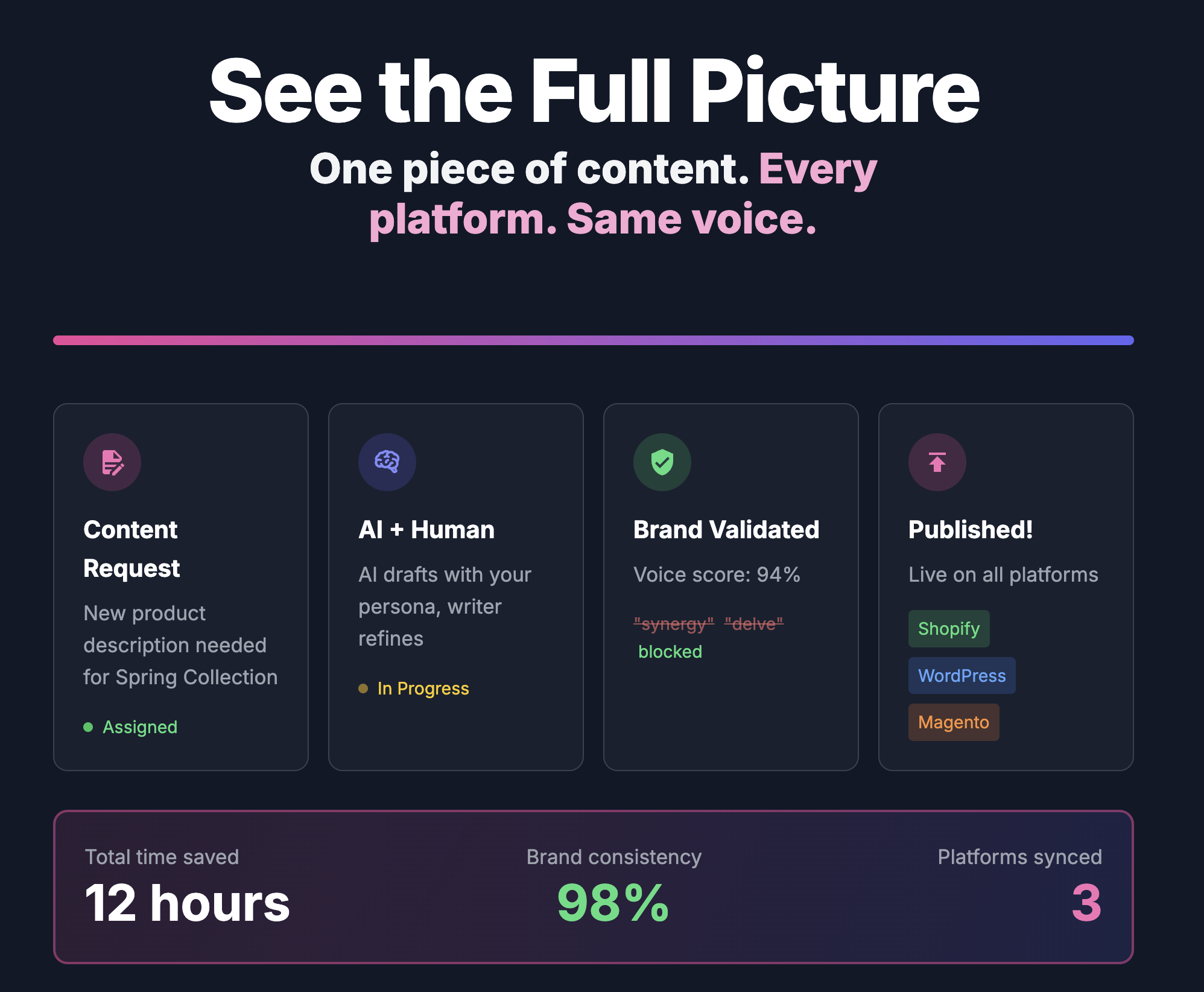
Content Cucumber handles the human side. Real writers, real editors, real quality control. AI can draft, but humans need to review. Anyone who tells you otherwise hasn't published enough AI content to see what happens when you skip the human layer.
RequestDesk is the orchestration layer. This is where workflow automations live. Content requests come in, get routed to the right person or AI, move through approval workflows, and publish to the right channels. We built AI interfaces that let non-technical users interact with AI without needing to understand prompts or APIs.
ContentBasis does the custom development. When off-the-shelf tools don't cut it, we build exactly what's needed. No more, no less.
The Integration Layer Matters
Most automation consultants miss this: content doesn't live in one place.
Your blog posts need to go to your CMS. Your product descriptions need to hit your e-commerce platform. Your social posts need to land on five different networks with five different formatting requirements. Your newsletter has its own workflow.
We spent a lot of time building integrations that work. Shopify, WooCommerce, Magento, WordPress, HubSpot, Klaviyo. The list keeps growing because our clients keep needing to publish to new places.
When someone offers to "automate your content workflow," ask them: which integrations do you have running? If the answer is "we'll build whatever you need," that's code for "you're about to pay for a lot of development hours."
The AEO/GEO Factor
The other thing changing fast is how people find content. Traditional SEO isn't dead, but AEO and GEO optimization (Answer Engine Optimization and Generative Engine Optimization) are becoming table stakes.
AI search tools like ChatGPT, Perplexity, and Google's AI Overview are reshaping how content gets discovered. If your content automation doesn't account for this shift, you're building for yesterday's internet.
We baked this into our workflow. Content gets optimized for both traditional search and AI discovery as part of the standard process. It's not an add-on or an afterthought.
Who Should You Trust With Your Content?
Look, I'm not saying outsourcing is always wrong. If you need a simple Zapier workflow to post your blog to social media, hire someone on Fiverr and call it a day. And of course Content Cucumber will supply you with all the content you need!
But if content is core to your business, if you're producing serious volume, if the quality and consistency of that content directly affects revenue, then you need to think carefully about what you're buying.
A consultant can build you a workflow. But do they understand why certain content performs and other content doesn't? Do they know which steps in your process are bottlenecks versus which ones just feel like bottlenecks?
We built RequestDesk and Content Cucumber so you can outsource to a team that understands content. The platform handles orchestration. The humans handle quality. You get both without building it yourself.
What This Means for You
If you're getting pitched on content automation, here are the questions to ask:
How many integrations do you have ready to go? Building integrations from scratch is expensive and error-prone.
How do you handle the human layer? Pure AI content without human review is a liability waiting to happen.
What do you know about AEO/GEO? If they look confused, they're building for 2022.
Can you show me a similar workflow you've built? Vague promises are easy. Working examples are hard.
Check out how our workflow works. We built this for ourselves first, made the mistakes, and now it's ready for you.