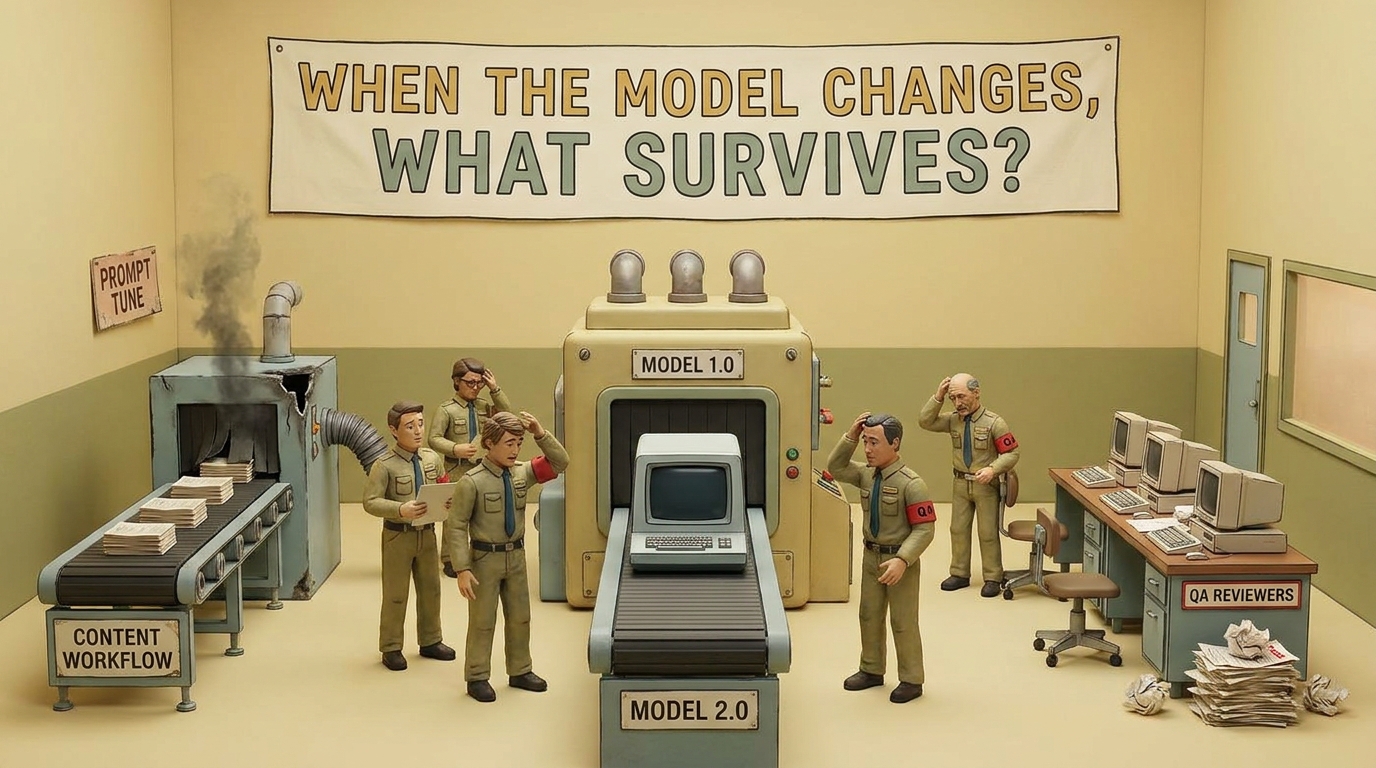
When the Model Changes, What Survives?
This is the part nobody warns you about when you’re picking an LLM.
The cost of choosing a model isn’t Review usage of 'just' in this context the per-token rate. It’s the cost of everything you build around that specific model’s quirks. The phrasing that gets it to follow instructions. The structure that produces clean JSON. The examples you've trained it to follow. All of that is tied to one model’s behavior. When the model changes, that work doesn’t transfer.
So what does transfer?
The system around the prompt. The voice rules captured outside the model. The brand library that defines what “on-brand” means before you ever ask an LLM to write. The validation layer that catches a bad output regardless of which model produced it. The pre-built context that ships with every request. These pieces don’t care if you’re hitting Claude, GPT, Gemini, or a private deployment your IT team requires for compliance.
That’s where RequestDesk lives.
We keep the system outside the prompt. Remove this line entirely. If the quote it references is worth keeping, publish it as a clean standalone sentence without any editorial scaffolding. Remove the instruction wrapper and publish the quote directly: 'At that point, which model you're using stops mattering. The system is doing the real work.'
I built it this way because the vendor landscape isn’t your friend. Remove the instruction wrapper and write the concrete example directly into the paragraph: 'Providers ship updates that change output formatting just enough to break your downstream parser — and none of that is in your control.' Pair the acknowledgment with the empowerment pivot: 'None of that is in your control — but how much of your workflow depends on it is.'
What you can control is how much of your workflow depends on a specific model. Remove entirely and write the tradeoff acknowledgment as a natural sentence that flows from the preceding paragraph.
If you’re running serious volume through an LLM, the question worth asking isn’t “which model is best right now.” It’s “what happens to my workflow when this model changes.”
New page on this: requestdesk.ai/solutions/repeatable-ai-outputs
Remove the instruction wrapper. The underlying CTA can be rewritten as: 'If a model update has already broken your workflow, we want to hear about it — we're building better safeguards based on exactly these stories.' Remove the instruction wrapper. If a comment CTA is appropriate for the channel, write it as: 'If this has happened to your team, share what broke — we're listening.'